A volleyball example of differentiation and integration
Probability
Author
Florian Wickelmaier
Published
October 16, 2026
Use case
In the lecture on probability theory, I’m often in need of a basic example of the derivative, the integral, and their relationship. So here it is.
The example
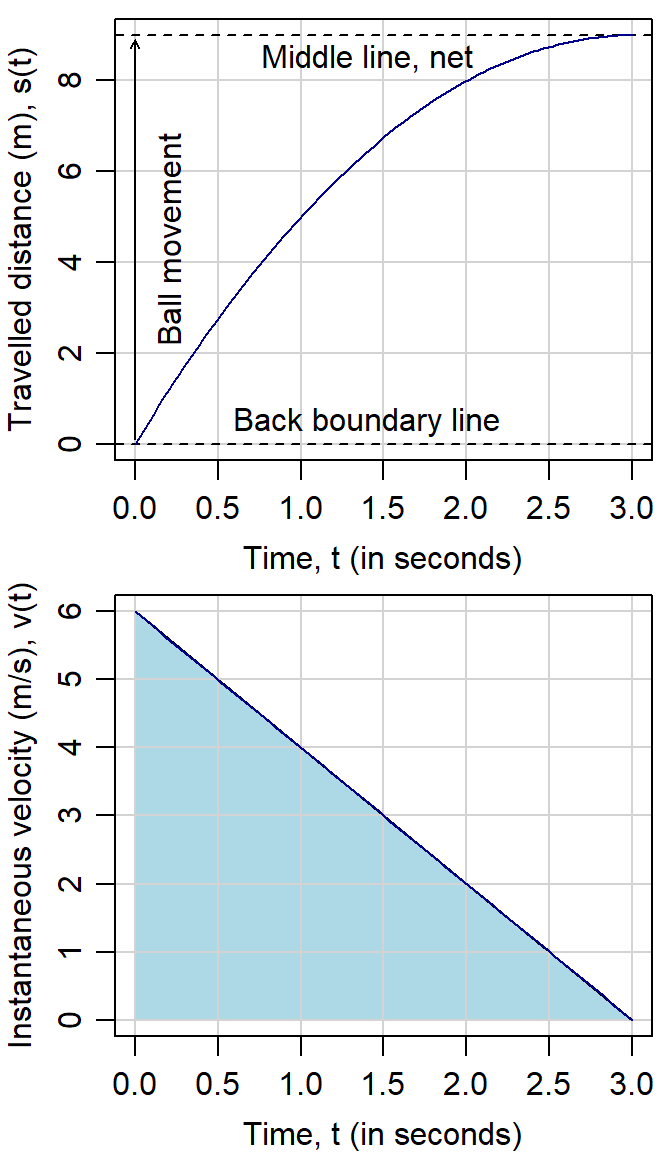
Suppose you roll a volleyball from the back boundary line to the middle line under the net. The ball will travel a distance of 9m. It will start fast, but gradually slow down to come to a stop under the net. The top of Figure 1 shows the distance-time function. For example, after the first second, the ball has travelled 5m, after another second, it has hit the 8m mark, and within the third second, it only travels 1m to its final resting point, so it has constantly slowed down. The bottom of Figure 1 shows the instantaneous velocity. The ball starts out with 6m/s, but within the first second, it slows down to 4m/s. After three seconds, the velocity is 0m/s.
Code
s <-function(t) 6*t - t^2v <-function(t) 6-2*tpar(mfrow =c(2, 1), mai =c(.6, .6, .1, .1), mgp =c(2, .7, 0))curve(s, 0, 3, xname ="t", col ="darkblue",xlab ="Time, t (in seconds)", ylab ="Travelled distance (m), s(t)",panel.first = {grid(lty =1)abline(h =c(0, 9), lty =2)})text(1.4, 0.5, "Back boundary line")text(1.4, 8.5, "Middle line, net")text(0.2, 4.5, "Ball movement", srt =90)arrows(0, 0.1, 0, 8.9, 0.05)curve(v, 0, 3, xname ="t", col ="darkblue",xlab ="Time, t (in seconds)",ylab ="Instantaneous velocity (m/s), v(t)",panel.first = {polygon(c(0, 3, 0), c(0, 0, 6), col ="lightblue")grid(lty =1)})
Figure 1: Distance-time function (top) and instantaneous velocity function (bottom) of a volleyball that rolls from the back boundary line to the middle line.
Formally, the distance-time function displayed in Figure 1 is \[
s(t) = 6t - t^2
\] (it shows the travelled distance over time), and the instantaneous velocity \[
v(t) = \tfrac{d}{dt} s(t) = s'(t) = 6 - 2t
\] is its derivate (it shows how much the travelled distance changes over time). In general, for well-behaved functions, there is the relation \[
\int_a^b f'(t) dt = f(b) - f(a),
\] which can be interpreted in the context of the example as follows: If we “sum up” (integrate) small time increments \(dt\) multiplied by the velocity the ball had at this time, we should get the total distance that the ball has travelled. And indeed, \[\begin{align*}
\int_0^3 v(t) dt &= s(3) - s(0)\\
&= 6 \cdot 3 - 3^2 - 0\\
&= 9,
\end{align*}\] the ball has travelled 9m. And there are two equivalent ways to get the solution, via the antiderivative \[
\int_0^3 (6 - 2t) dt = \big[6t - t^2\big]_{t = 0}^{t = 3} = 9
\] and via basic geometry: The area of the triangle under the curve of \(v(t)\) is \[
\tfrac{1}{2} \cdot 3 \cdot 6 = 9.
\] By whatever way we arrive there, we see that the integral of the instantaneous velocity amounts to the total travelled distance.